Infinity Personality Development

Building Your First Resume, One Section at a Time
Put your potential on paper—with clear sections, relevant examples, and a story you can confidently explain.

Building Your First Resume
A blank resume can make you feel as though you have nothing to offer. You may not have a job title yet, but you have probably solved problems, contributed to a project, supported an event, learned a tool, or taken responsibility for something. The starting point is recognising what those experiences reveal about you.
Your first resume should help an employer understand what you can contribute and where you are ready to learn. Here is how to build it, one section at a time.
Before you write: choose a direction
Pick a role or a small group of related roles. Read a few job descriptions and note the recurring tasks and skills. Then make a list of experiences that could demonstrate them: academic projects, internships, part-time work, volunteering, student activities, or responsibilities in a family business.
For a marketing role, a college campaign may deserve more space. For an operations role, event coordination or record-keeping may be more relevant. Keep a longer master record of your experiences, then select what belongs in each application.
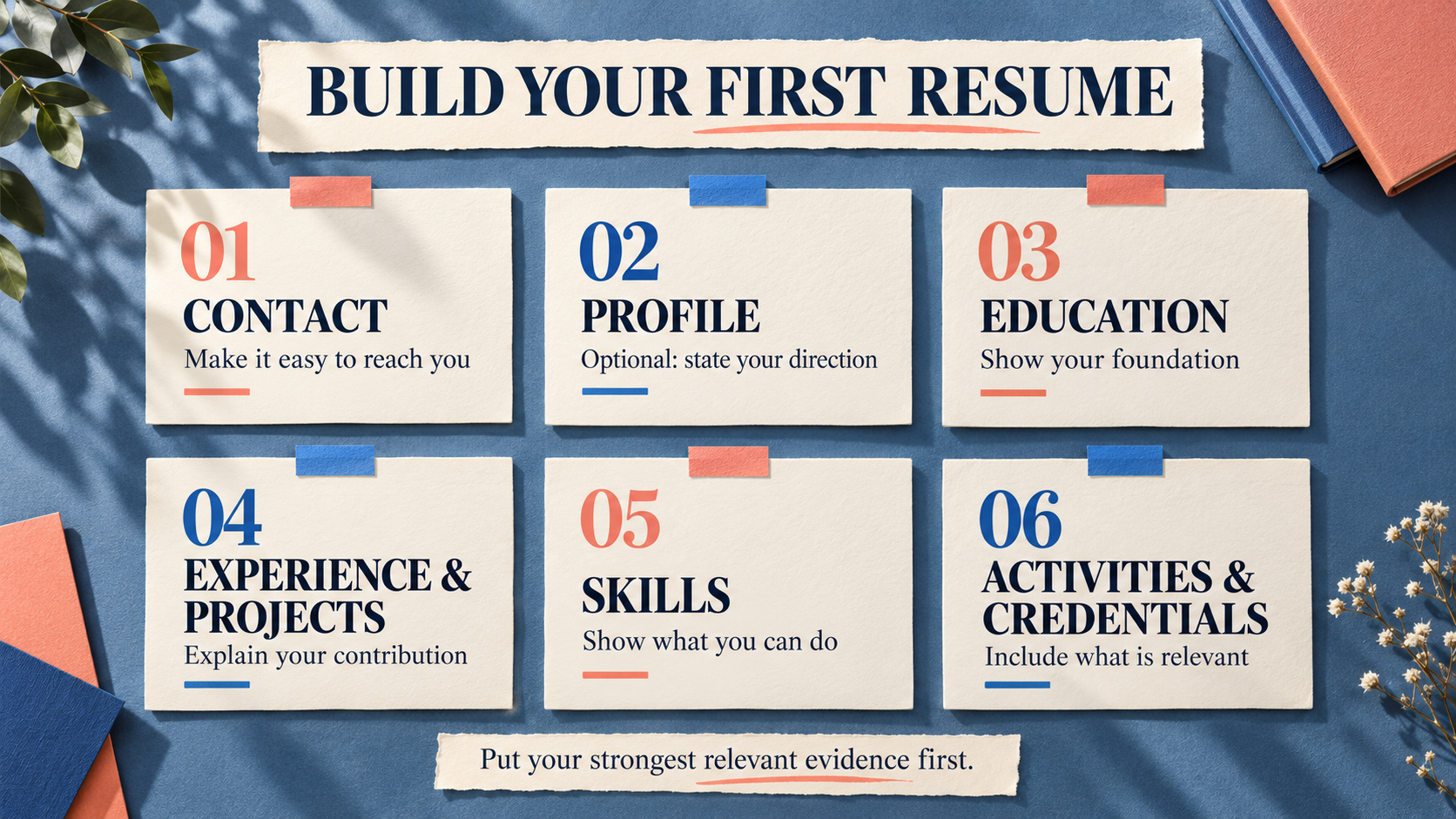
1. Contact details: make the next step easy
Start with your name, a professional email address, phone number, and city or region. Add a current LinkedIn profile or portfolio if it supports your application. Test every link and make sure shared work samples can actually be opened.
For most general corporate applications, keep personal information to what is needed to contact you. Leave out identity numbers, family details, and a full street address. Photo and personal-detail conventions vary by country and role, so check legitimate application instructions rather than copying every field from an old template.
2. Profile: give direction, if it adds value
A short profile is optional. Include one when it quickly connects your background to the role; skip it if it only repeats the rest of the page. Avoid opening with a long sentence about wanting to work for a prestigious organization.
Illustrative profile: “Commerce graduate with project experience in customer research and spreadsheet analysis, seeking an entry-level marketing role. Comfortable presenting findings and coordinating tasks within a team.”
This gives the reader a direction and specific areas to explore. Write your own version from experiences you can discuss. The examples in this article are fictional illustrations, not wording or achievements to claim as your own.
3. Education: establish your foundation
List your qualification, institution, and completion date—or expected completion date if you are still studying. Include a specialization where relevant. State marks or grades accurately, with their scale, when requested or when they strengthen the application.
Keep coursework selective. A few subjects relevant to the vacancy are more useful than a complete syllabus. Include school-level results when the employer or campus process asks for them. Education can sit near the top for a new graduate; a strong relevant internship may justify putting experience first.
4. Experience and projects: explain your contribution
Paid employment is one way to show experience. A college project, volunteer assignment, part-time role, or family-business responsibility can also provide evidence. Label the experience accurately: an academic assignment should not appear to be paid client work.
For each entry, include the role or project title, organization or context, dates, and a few focused bullet points. Separate projects and employment into their own sections if that makes the page easier to follow.
A useful writing pattern is: action + task + method or purpose + outcome, where known. Explain your own contribution to group work and use numbers only when you can substantiate them.
Before: “Helped organize a college event.”
Stronger: “Coordinated speaker confirmations and maintained the run sheet for a college panel discussion, keeping the organizing team informed of schedule changes.”
The stronger version shows what the person actually did without inventing a percentage improvement. A completed deliverable, a problem resolved, or a process supported can be meaningful even without a numerical result.
If you do not yet have a suitable example, build one: analyze a public dataset, develop a sample campaign, create a small website, or volunteer for a defined task. Record what you did and learned, and clearly label self-directed or simulated work.
5. Skills: list what you can demonstrate
Choose skills that relate to the role and describe them precisely. “Excel: formulas, pivot tables, and basic charts” is more informative than “good computer knowledge”—provided you can demonstrate those abilities.
Include relevant tools, methods, and language proficiency. Show communication, teamwork, and initiative through your project or experience bullets as well. Avoid rating yourself with decorative bars or stars: they give little context about what you can actually do.
6. Activities and credentials: keep the evidence relevant
Include selected certifications, awards, leadership roles, or community involvement that add something new. Name the issuing organization and completion date for credentials, and distinguish a course in progress from one completed.
An activity earns its place when you can explain the responsibility behind it. Managing a debate society’s schedule, tutoring younger students, or handling registrations may say more than simply listing club membership. Group these items or split them into short sections according to what you have to show.
Make the page easy to read
For many first-time applicants, one page is a useful starting target. Keep enough space for relevant evidence without shrinking the text to fit an arbitrary limit. Use a simple layout, clear headings, consistent dates, and recent entries first within each section. Harvard’s resume guide similarly emphasizes concise, factual writing and readable organization.
A straightforward single-column design is a sensible default. If an application portal extracts information from your document, check and correct the imported fields. Follow the requested file format; when sending a PDF, export a text-based file and confirm that the text can be selected. No design or keyword formula guarantees that a resume will pass screening.
Use AI to edit your evidence
AI can help shorten a bullet, spot repetition, or suggest questions that reveal missing detail. Start with your own facts and remove private information before sharing a draft with a tool.
Try this prompt: “Make this resume bullet clearer without adding achievements, numbers, skills, or responsibilities. Ask me for missing details rather than inventing them.”
Check every suggested change. If you cannot explain a claim in an interview, revise or remove it. Harvard’s guidance on AI-assisted resume writing supports using AI to improve your draft while keeping the resume an authentic account of your experience.
Before you send: a final check
- Does the resume make sense for this particular role?
- Can you explain and support every skill, result, and credential?
- Do your bullets distinguish your contribution from the team’s work?
- Are contact details, dates, spelling, and links correct?
- Does the exported file look right, and does it meet the application instructions?
- Have you saved it with a clear filename, such as Firstname_Lastname_Resume.pdf?
A first resume is a starting point
Your resume will grow as your experience does. For now, give the reader a clear, honest picture of your strengths and the work you are ready to take on. A small number of well-explained experiences can tell a more useful story than a crowded page of unsupported claims.
At Infinity, CV preparation and mock interviews help learners connect what is on the page with what they say in the room. Explore our Personality Development Program to practice presenting your experience with clarity and confidence.